In 1903, Kodak introduced the No. 3A Folding Pocket Kodak.[1] The camera, designed for postcard-size film, allowed the general public to take photographs and have them printed on postcard backs, usually in the same dimensions (3-1/2" x 5-1/2") as standard vintage postcards. Many other cameras were used, some of which used glass photographic plates that produced images that had to be cropped in order to fit the postcard format.
In 1907, Kodak introduced a service called "real photo postcards," which enabled customers to make a postcard from any picture they took. ETC

new episodes available every three weeks wherever you get your podcasts
~ EPISODE 1 ~
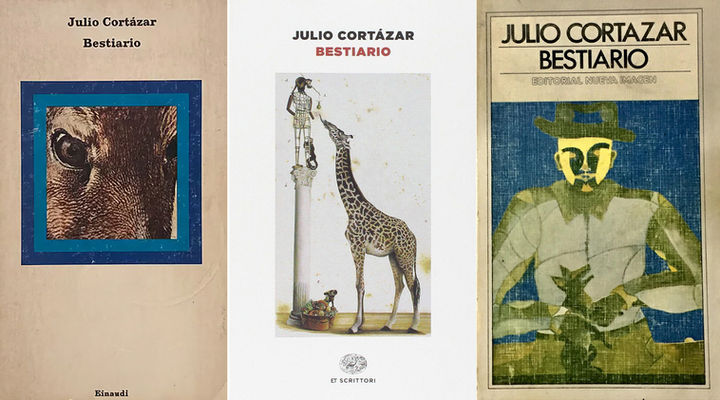
On "House Taken Over" by Julio Cortázar
EPISODE 1: House Taken Over, by Julio Cortázar
Listen on Spotify • YouTube • Apple Podcasts
“House Taken Over” is the bare skeleton of a haunted house story, every scrap of irrelevant detail flensed away. Like Ballard’s “Garden of Time” it’s a tale of class struggle & the terrifying rise of the proletariat as seen by the comfortable rich. Like Camus’s “La Peste”, it’s a fable about the insidious approach of fascism and the plight of millions of war refugees. But most of all it’s completely and terrifyingly uncanny, sharing DNA with Borges and Lovecraft, with Kafka’s “The Burrow”, with “The Balcony” of Jean Genet, Poe’s “Fall of the House of Usher”, Freud’s 1919 essay "Das Unheimliche", the Diary of Anne Frank, Shirley Jackson’s “We Have Always Lived in the Castle”, the wartime torch-song “My Sister and I (We Don’t Talk About That)”, Richard Mattheson’s inversion of the very concept of monstrosity in “I Am Legend”, Amitav Ghosh’s brilliant examination of climate derangement, various Gothic horrors, and the plight of the passive, childlike Eloi in H G Wells’ “Time Machine”, weakened by generations of absolute ease and destined to be devoured by the bestial cannibalistic Morlocks. “I spent my childhood in a haze of goblins and elves”, wrote the great Argentinean fabulist Julio Cortázar, “For me, the fantastic was perfectly natural; I had no doubts at all about it. That’s just the way things were.” Championed by Jorge Luis Borges, persecuted by the dictator dictator Juan Peron, Cortazar fled to Paris and became an international youth-culture icon. His stories were made into films by Godard & Antonioni, and Pablo Neruda said of him, in his heyday, "Anyone who doesn't read Cortazar is doomed. Not to read him is a serious invisible disease which in time can have terrible consequences…”
or click here for the full transcript
00:45 - 13:13 PART ONE: A Haze of Goblins & Elves: Biography of Cortazar
15:46 - 31:15 PART TWO: You Can Live Without Thinking: Story Synopsis
33:24 - 58:20 PART THREE: Class war, folie a deux, or the unheimliche: Three Lenses
60:07 - 71:13 PART FOUR: Madness Made Manifest
The featured songs this week were “On Muted Strings” by Albert Alan Owen (13:13-15:46), “First Ghazal for Piano” by Alan Hovhaness (31:13-33:24), “Third Prelude in Quarter-tones” by Ivan Wyschnegradsky (58:20-60:07), and "My Sister and I (We Don't Talk About That)" by Bob Eberly & Jimmy Dorsey. The incidental music was written by Monk Parker and recorded by Orchestra of Beasts and Sarah Gautier, except for bits and pieces of "Sonar" by Alan Hawkshaw, and "Yesterdays" by the Jackie Gleason Orchestra, which can be heard here and there in the background. Our opening theme is "Hellcat" by Alden Shuman and the closing music is "Strange Aquarium" by Alan Feanch.
Our sister project LOST WORLD RADIO is a 24/7 broadcast of sad old musical obscurities like these. Do please feel free to listen in.
Texts & films cited in this episode:
The Rats in the Walls, H. P. Lovecraft
The Burrow, Franz Kafka
The Fall of the House of Usher, E. A. Poe
Collected fiction of Jorge Luis Borges
The Balcony, Jean Genet
The Man Who Was Thursday, G. K. Chesterton
Das Unheimliche, Sigmund bloody Freud
We Have Always Lived in the Castle, Shirley Jackson
I Am Legend, Richard Mattheson
The Great Derangement, Amitav Ghosh
The Time Machine, H. G. Wells
The Garden of Time, J. G. Ballard
Blow-Up, Michelangelo Antonioni
Weekend, Jean-Luc Godard.
~ EPISODE 2 ~
Apocalyptic Landscapes of J. G. Ballard
(Part One)
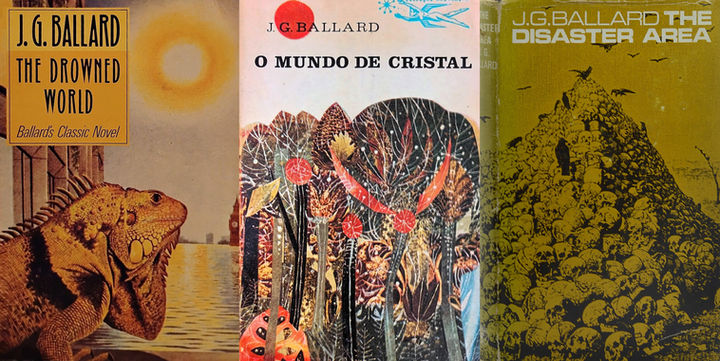

Listen on Spotify • YouTube • Apple Podcasts
Once there was a bright, adventurous young English boy who lived in an exotic, garish land with his wealthy, inattentive parents. Though he saw marvels & terrors through the windows of his father’s sleek black car, he lived an ordered & untroubled life. Then one day war came to Shanghai, and he was taken abruptly from the world of the familiar and dropped into a dark mirror realm of strange marvels and fearsome horrors: Lunghua Internment Camp. For three years he lived an indisputably magical fairy tale, but of the darkest sort ~~ a fairy tale to make even the Brothers Grimm blanch ~~ in this upside-down place, this goblin-world, locked away very far from any sort of order or civilization. For the rest of his long life he carried in his heart an unwavering knowledge of the chaotic dream world which he knew pressed up against the surface of the mundane, and he spent the next six decades writing thinly disguised accounts of the perilous, uncanny domain he once called home… a lush, violent environment, always outside the normal flow of time, and evolving in ways indifferent to human affairs or even existence, transformed almost beyond recognition but sliding towards more profound change still, towards some entropic end-point of perfect post-human stillness… dreamlike & beautiful worlds whose logic inexorably makes itself at home in these characters, molding their psyches in its own image. In the Drowned World (1962) solar flares have caused ocean levels to rise, and the characters float through sub-tropical lagoons above a mostly-submerged London. In The Burning World (1964) industrial pollution has caused a climate-feedback loop that in the end results in unliveably hot climates and a near-total drought, rendering the English town of Mount Royal a parched, dune-covered desert. And in The Crystal World (1966) a mysterious process of crystallization has begun to transform a small corner of the Cameroonian jungle into a jeweled, lethal wonderland. The landscapes that result ~~ a forced marriage of the collapsing artifacts of man and the resurgent Nature overtaking & enveloping them ~~ are sultry, dreamlike, ultimately fatal. Once entered into by the reader, they can’t be left. They will stay with you (or you in them) forever.
or click here for the full transcript
00:48 - 18:50 PART ONE: A Genius for the Perverse and the Obsessional
21:21 - 38:40 PART TWO: A Reflection That Has Somehow Lost Its Original
40:58 - 61:15 PART THREE: Sacred Geometries of Decay
Featured songs this week were the "Fourth Unpublished Folio for Ondes Martenot" of Olivier Messiaen (18:50 - 21:21), “Pesca Subacquea” by A. R. Luciani (38:40 - 40:58), and “Summertime” by the Jay Gordon Concert Orchestra (62:06 - 65:23). The incidental music was written by Monk Parker and recorded by Orchestra of Beasts and Sarah Gautier. Our opening theme is "Hellcat" by Alden Shuman and the closing music is "Strange Aquarium" by Alan Feanch.
Our sister project LOST WORLD RADIO is a 24/7 broadcast of sad old musical obscurities like these. Do please feel free to listen in.
Texts & films cited in this episode:
Collected Stories of J. G. Ballard
The Psychotic Geometry of the Real, S C Hickman
Tinker Tailor Soldier Spy, John le Carre
A Clockwork Orange, Anthony Burgess
War of the Worlds, H. G. Wells
There is No Antimemetics Division, Qntm
Man and his Symbols, Carl Jung
~ EPISODE 3 ~
Apocalyptic Landscapes of J. G. Ballard
(Part Two)

Listen on Spotify • YouTube • Apple Podcasts
This week we’ll see yet another man dragged backward through time, just like those in the Drowned & Crystal Worlds, into a violent subtropical dream, into landscapes so baroque and savage as to defy belief. The man this time, though, is Ballard himself, and the world is our own. The real world of his un-imagined past, transformed by war, is every bit as outlandish, every bit as science-fictional as his invented futures. In the literature of the uncanny, Weird War has a long and extraordinary history, from Wilfred Owen’s 1918 trench-murder of his doppelgänger in “Strange Meeting” to the Jungle of Screaming Souls in Bao Ninh’s Vietcong battle-journal “the Sorrow of War”, from Ambrose Bierce’s 1890 “Incident at Owl Creek Bridge” to the 2017 atomic-bomb detonation scene in Twin Peaks, set to Penderecki’s equally weird, cold-sweat-inducing “Threnody for the Victims of Hiroshima”. War both reflects and generates weirdness in fiction and popular culture, and of all the wars ever fought by man, World War Two was by all accounts the maddest, the most surreal, the most preternatural. Real-world uncanniness swept from continent to continent like a pandemic, infecting the child that would become JG Ballard along with tens of millions of others. Every fear contained in the pantheon of supernatural literature comes to life in war. Angry revenants, cursed areas, fire raining from the sky, mad scientists, zombies, invisible death, torturing demons, pits of liquid flame ~~ it all manifests, often consciously. Consider Nazi Germany’s “werwolf” program of post-war resistance guerrillas, indistinguishable from the populace by day but transforming into a terrible force by the light of the moon; or the “night witches” of the soviet union’s all-female 588th night bomber regiment, gliding low over German positions with their engines shut off and only the wind noise across their dark wings to reveal their spectral presence before the explosions began. And so on, almost infinitely. Name a horror trope and it has come true in modern war. Monsters roam the earth. Random people are unexpectedly torn from their lives and dropped, in the blink of an eye, into dimensions darker than any found in fiction. Entire societies go stark mad and write their madness in blood and fire across the landscape. Man is wolf to man, and god, as an organizing principle and a giver of comfort, is considerably more absent than usual. Ballard believed in his bones that the death-haunted, baroque landscapes of his youth, in all their capacity to suddenly rewrite their own forms and laws in chaotic, lethal, spectacular ways, were always still just over the hill, just beyond the hedge. On any given day you might open your front door and find the world transformed utterly, and you with it…
or click here for the full transcript
00:43 - 13:13 PART ONE: A Bright and Bloody Kaleidescope
15:46 - 31:13 PART TWO: Invaded by the Sky
33:24 - 58:20 PART THREE: Weird War & the Reality of the Uncanny
Our featured songs this week were “Evening at the Lake” by Sachiko Miyamoto, Kohachiro Miyata & Yuji Mori, A. R. Luciani’s “Pesca Subacquea”, and “Lament for Javanette” by Barney Bigard. The incidental music was written by Monk Parker and recorded by Orchestra of Beasts and Sarah Gautier. Our opening theme is "Hellcat" by Alden Shuman and the closing music is "Strange Aquarium" by Alan Feanch.
Our sister project LOST WORLD RADIO is a 24/7 broadcast of sad old musical obscurities like these. Do please feel free to listen in.
Texts & films cited in this episode:
Empire of the Sun, J. G. Ballard
A Philosophical Enquiry into the Origin of Our Ideas of the Sublime and Beautiful, Edmund Burke
Modern Painters, John Ruskin
Thus Spake Zarathustra, Friedrich Nietzsche
the Augsburg Book of Miracles
Strange Meeting, Wilfred Owen
The Sorrow of War, Bao Ninh
An Occurence at Owl Creek Bridge, Ambrose Bierce
Threnody for the Victims of Hiroshima, Krzysztof Penderecki
The Selfish Gene, Richard Dawkins
FUTURE EPISODES